How to Start a Tech Startup as a Non-Technical Person (2026 Edition)
Are you hesitating to start a tech startup because you’re “not technical enough”?
In 2026, that excuse no longer holds.
We are living in an era where no-code tools, AI copilots, global talent platforms, and remote-first culture have fundamentally changed how startups are built. Yes, many iconic tech companies were founded by engineers. But many were also started by people who couldn’t write a single line of code — and still built industry-defining companies.
The real question is no longer “Can a non-technical person start a tech startup?”
It’s “Can you solve a real problem and build the right team to execute it?”
Let’s break this down strategically — with modern, legitimate 2026 approaches.
You Don’t Need to Be Technical — You Need to Be Valuable
It’s true that many tech giants were started by deeply technical founders. But many others were not.
Consider:
- Larry Ellison, founder of Oracle Corporation — he came from a sales and business background.
- Jack Ma, founder of Alibaba Group — an English teacher before building one of the largest tech ecosystems in the world.
- Jessica Scorpio, co-founder of Getaround — political science graduate.
- Tim Westergren, founder of Pandora Media — a musician and composer.
Even the founders of Google — Larry Page and Sergey Brin — later brought in Eric Schmidt to provide experienced business leadership.
The pattern is clear:
Tech startups are not about coding.
They are about problem-solving, leadership, execution, and market fit.
The 2026 Blueprint for Non-Technical Founders
Let’s rebuild this guide with modern startup realities.
1. Validate the Problem Before You Build Anything
Most startups fail not because of bad technology — but because they build something nobody truly needs.
As a non-technical founder, this is your superpower.
Ask These Critical Questions:
- What painful problem am I solving?
- Who experiences this problem daily?
- How are they currently solving it?
- Would they pay for a better solution?
- How much would they realistically pay?
In 2026, validation is easier than ever:
- Run surveys using AI-generated question sets
- Launch landing pages in hours
- Run small paid ad experiments
- Conduct 30–50 customer interviews
If customers won’t commit time or money early — stop.
Validation is cheaper than failure.
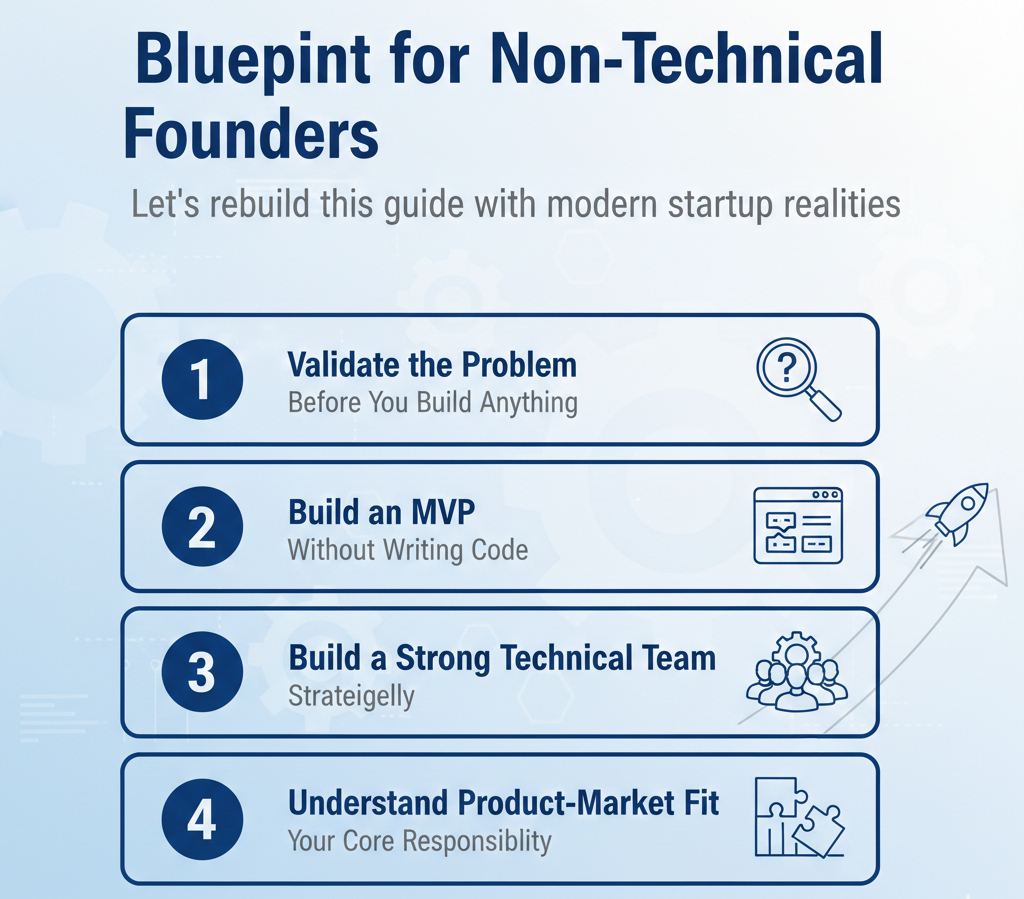
2. Build an MVP Without Writing Code
In 2026, you have options that didn’t exist a decade ago.
You no longer need a full engineering team to test an idea.
Option A: No-Code & Low-Code Platforms
You can build working prototypes using:
- Bubble
- Webflow
- Glide
- FlutterFlow
- Airtable-based apps
Many profitable SaaS companies started this way.
Option B: AI-Assisted Development
AI coding tools can now:
- Generate backend APIs
- Build UI components
- Debug code
- Create databases
You can supervise development without writing everything yourself.
Option C: Technical Partner
Find a technical co-founder aligned with your vision and values.
Option D: Freelancers or Agencies
Use platforms like:
- Upwork
- Toptal
- Lemon.io
But remember: agencies build products; co-founders build companies.
3. Build a Strong Technical Team (Strategically)
In early stages, hiring a full-time senior developer is expensive and risky.
Instead:
- Start with contract developers
- Use milestone-based payments
- Maintain code ownership
- Use version control (GitHub organization under your company)
- Keep documentation centralized
If you bring a CTO or technical co-founder:
Look for:
- Product thinking (not just coding ability)
- System design knowledge
- Ownership mentality
- Clear communication skills
- Long-term commitment
Avoid “code-only” developers who lack product vision.
4. Understand Product-Market Fit (Your Core Responsibility)
As a non-technical founder, your job is:
- Product strategy
- Market positioning
- Sales
- Partnerships
- Fundraising
- Hiring
- Vision
Your mission is to achieve product-market fit before you burn capital.
Product-market fit means:
Customers are pulling your product out of your hands faster than you can deliver it.
Until then, optimize for learning — not scale.
What Every Non-Technical Founder Must Do
1. Talk to Customers Constantly
Your unfair advantage is clarity.
Technical founders sometimes fall in love with features.
You must fall in love with problems.
Have weekly conversations with users:
- Why did they sign up?
- Why did they cancel?
- What frustrates them?
- What would make them pay more?
Data is useful. Conversations are gold.
2. Create Clear Mockups & Product Specs
You don’t need to code.
But you must communicate.
Use:
- Figma wireframes
- Clickable prototypes
- User journey maps
- Notion product documentation
Avoid vague instructions like:
“Make it look modern.”
Instead say:
“When the user clicks X, the system should do Y in under 2 seconds.”
Precision saves money.
3. Pre-Sell Before You Scale
One of the strongest validation methods in 2026 is pre-selling.
Ways to pre-sell:
- Early access pricing
- Founding member programs
- Beta subscriptions
- Waitlist deposits
If people won’t pay even a small amount upfront, your value proposition may not be strong enough.
Revenue validates better than compliments.
4. Search for the Right Technical Co-Founder (If Needed)
You don’t need a co-founder.
But if you choose one, choose carefully.
Look in:
- Startup communities
- Hackathons
- Founder networking events
- Accelerator programs
Evaluate:
- Integrity
- Humility
- Coachability
- Emotional maturity
- Conflict resolution ability
Skills can improve. Character rarely changes.
5. Learn Enough Tech to Avoid Being Blind
You don’t need to code.
But you must understand:
- What is an API?
- What is a database?
- What is cloud hosting?
- What is cybersecurity risk?
- What affects scalability?
- What is technical debt?
In 2026, ignorance is optional.
Take online courses. Watch technical breakdowns. Use AI tutors.
The more you understand, the harder it is for someone to mislead you.
Mistakes Non-Technical Founders Must Avoid
- Outsourcing without understanding the product
- Giving away 50% equity too early
- Hiring friends instead of professionals
- Ignoring legal agreements
- Building features instead of solving pain
- Scaling marketing before achieving product-market fit
The Reality of 2026: Technology Is No Longer the Barrier
The biggest barriers now are:
- Clarity
- Discipline
- Customer insight
- Leadership
- Distribution
Technology is increasingly commoditized.
Execution is not.
Final Thoughts
Starting a tech startup as a non-technical person is not only possible — it’s increasingly common.
Your job is not to compete with engineers.
Your job is to:
- Identify meaningful problems
- Communicate clear vision
- Assemble the right people
- Secure customers
- Build sustainable systems
Technology builds products.
Leadership builds companies.
If you combine resilience, customer obsession, and strategic thinking, you can absolutely build a successful tech startup — even if you’ve never written a line of code.
And in 2026, that may actually be your advantage.
# Written by Elliyas Ahmed