How to Get Paid to Test Products on Amazon: Step-by-Step Guide for Beginners (2026)
If you’ve ever wanted to test products for Amazon and get paid, you’re not alone. The idea of receiving new gadgets, kitchen tools, beauty products, or even high-ticket electronics before the general public is incredibly appealing. In 2026, however, Amazon product testing looks very different from what it did a few years ago.
What used to be a simple “write a review and get free stuff” model has evolved into something much bigger. Today, Amazon product testing sits at the intersection of the creator economy, user-generated content (UGC), and affiliate marketing. Written reviews still matter, but video, photos, on-site commissions, and compliance rules now define success.
This is your complete beginner’s roadmap.
The 2026 Reality: It’s Not Just Reviews Anymore
Let’s start with the truth.
Amazon does not pay people directly to leave positive reviews. In fact, paying for positive reviews violates Amazon’s policies and can result in permanent account bans. In 2026, Amazon uses advanced AI systems to detect suspicious review behavior, including patterns that suggest incentivized or AI-generated reviews.
So how do people really get paid?
They do it through a combination of:
- Amazon Vine (invite-only product access)
- The Amazon Influencer Program
- On-site video commissions
- UGC marketplaces
- Legitimate third-party sampling platforms
- Affiliate earnings in high-margin niches
The game has shifted from “reviewer” to “micro-creator.”
Step 1: Meet Amazon’s Base Eligibility Requirements
Before you even think about getting paid, you must be eligible to post reviews.
To leave reviews on Amazon in 2026, you must have spent at least $50 in the last 12 months using a valid credit or debit card. This is a hard requirement.
If you have not met this threshold:
- Make a few legitimate purchases.
- Avoid gift card-only purchases if you are trying to unlock reviewing privileges.
Without review eligibility, nothing else matters.
Step 2: Optimize Your Public Amazon Profile
Most beginners skip this step. That’s a mistake.
Your public profile is your credibility layer.
Here is how to optimize it:
- Use a clear, professional photo.
- Write a short bio highlighting your interests. Examples:
- “Tech Enthusiast and Home Automation Reviewer”
- “Home Chef Testing Everyday Kitchen Tools”
- “Fitness and Recovery Gear Explorer”
- Keep your tone consistent across reviews.
Why this matters:
Amazon Vine’s internal algorithm looks at reviewer consistency, helpful votes, and engagement patterns. A complete, professional profile increases perceived trustworthiness both to Amazon and external brands.
Step 3: Build a High-Quality “Helpful” Review History
This is where most people either build real momentum or fail early.
In 2026, Amazon prioritizes:
- Reviews with original photos
- Short demo videos
- Clear pros and cons
- Structured bullet points
- Honest feedback, including negatives
Helpful votes from other customers are now one of the strongest signals that your reviews matter.
Best practices:
- Review products you already own.
- Include real-world usage scenarios.
- Avoid generic language.
- Never copy and paste manufacturer descriptions.
- Do not use AI to generate full reviews. Amazon has systems to detect LLM-style writing patterns.
If Amazon flags your account for AI-generated reviews, you risk losing reviewing privileges permanently.
Consistency beats volume. Ten strong reviews outperform fifty shallow ones.
Step 4: Aim for Amazon Vine (The Gold Standard)
When people search “how to test Amazon products for free,” they usually discover Amazon Vine.
Amazon Vine is Amazon’s official, invite-only reviewer program. Selected reviewers, called Vine Voices, receive free products in exchange for unbiased feedback.
Important facts:
- You cannot apply.
- You must be invited.
- You are not paid cash.
- You must provide honest reviews.
- The value of products may be considered taxable income in certain countries if it exceeds reporting thresholds.
In the United States, for example, if the value of Vine products exceeds $600 in a calendar year, it may be considered taxable income.
Pros:
- 100 percent legitimate
- High-value items
- Early access to products
Cons:
- Invite-only
- No direct salary
- Tax implications
Vine is not a shortcut. It is a reward for long-term credibility.
Step 5: Apply for the Amazon Influencer Program
This is where 2026 gets interesting.
The Amazon Influencer Program allows creators to:
- Build a storefront
- Upload product demo videos
- Earn commissions
- Earn On-Site Commissions when customers watch videos directly on product pages
You do not need millions of followers. Even small but engaged audiences on TikTok, YouTube, or Instagram can qualify.
Why this matters:
On-Site Commissions mean you can earn when shoppers watch your product video directly on Amazon, even if they did not click your affiliate link.
This is one of the most overlooked earning models in 2026.
The most successful testers now combine:
- Honest product testing
- Short demo videos
- Affiliate monetization
You move from “reviewer” to “content asset creator.”
Step 6: Join UGC Marketplaces
Brands no longer just want reviews. They want content they can reuse in ads and product listings.
UGC marketplaces connect you with brands that pay for product videos.
Popular platforms include:
Typical payouts range from $50 to $300 per video depending on niche, quality, and brand budget.
You may:
- Receive a free product
- Get paid cash
- License your video to the brand
This is closer to a real product tester job than traditional reviewing.
Step 7: Register With Legitimate Third-Party Sampling Sites
If you are just starting out and want hands-on experience, third-party sampling sites are useful.
Examples include:
These platforms send products for real-world testing in exchange for feedback. Compensation varies, but they are generally legitimate.
Avoid platforms that:
- Demand positive reviews
- Require your Amazon login
- Promise guaranteed high income
- Offer reimbursement only after a 5-star rating
If reimbursement is tied to positivity, walk away.
Compliance in 2026: What You Must Know
FTC Consumer Review Rule
The Federal Trade Commission strictly prohibits incentivized positive reviews.
If you receive:
- Free products
- Discounts
- Payment
You must clearly disclose the relationship. Examples:
- “Received for free in exchange for honest feedback.”
- “Ad”
- “Sponsored”
Failure to disclose can:
- Lead to brand penalties
- Result in Amazon account bans
- Create legal risk
Honesty is not optional.
Amazon’s AI Detection Systems
Amazon now uses AI to detect:
- Repetitive review structures
- Suspicious rating patterns
- Coordinated review activity
- AI-generated writing patterns
Using AI as a grammar assistant is fine. Using AI to fully generate fake or generic reviews is extremely risky.
Your real voice is safer than a perfect robotic one.
Tax Implications
In some countries, including the U.S., the fair market value of free products may be considered taxable income once certain thresholds are exceeded.
Track:
- Product value
- Payments received
- UGC earnings
Treat this like a side business, not a hobby.
Pros and Cons of Amazon Product Testing in 2026
Pros
High potential compensation
You can receive high-ticket items like TVs, appliances, and smart devices. Affiliate and UGC income can add real cash flow.
Flexibility
You choose products aligned with your interests.
Skill growth
You build skills in:
- Digital marketing
- Video editing
- Copywriting
- Product analysis
Exclusivity
Early access to products before general release.
Cons
No guaranteed salary
Income fluctuates with demand, seasonality, and algorithm changes.
Discipline required
UGC deadlines and content quality standards are real.
Compliance risk
Violating disclosure rules or review policies can get you banned.
Vine exclusivity
You cannot apply directly.
The Most Profitable Niches in 2026
If you want to maximize income, niche selection matters.
Amazon commission rates vary by category.
High-Performing Niches
Amazon Games – 20%
Luxury Beauty – 10%
Amazon Haul – 7%
Handmade and Digital – 5%
Kitchen and Automotive – 4.5%
Amazon Devices – 4%
Higher commissions mean higher earning potential per sale.
Emerging High-Value Micro-Niches
Beyond commission percentages, brands pay the most for UGC in “prosumer” categories.
Biohacking and Longevity
Red light therapy panels, smart sleep masks, recovery tools.
Pet Tech
AI-tracking pet cameras, smart feeders, self-cleaning litter systems.
Creator Economy Gear
Portable RGB lights, AI gimbals, compact studio equipment.
Energy Independence
Smart thermostats, energy monitors, efficiency devices.
These niches attract serious marketing budgets.
How to Spot Real vs Fake Amazon Product Testing Offers
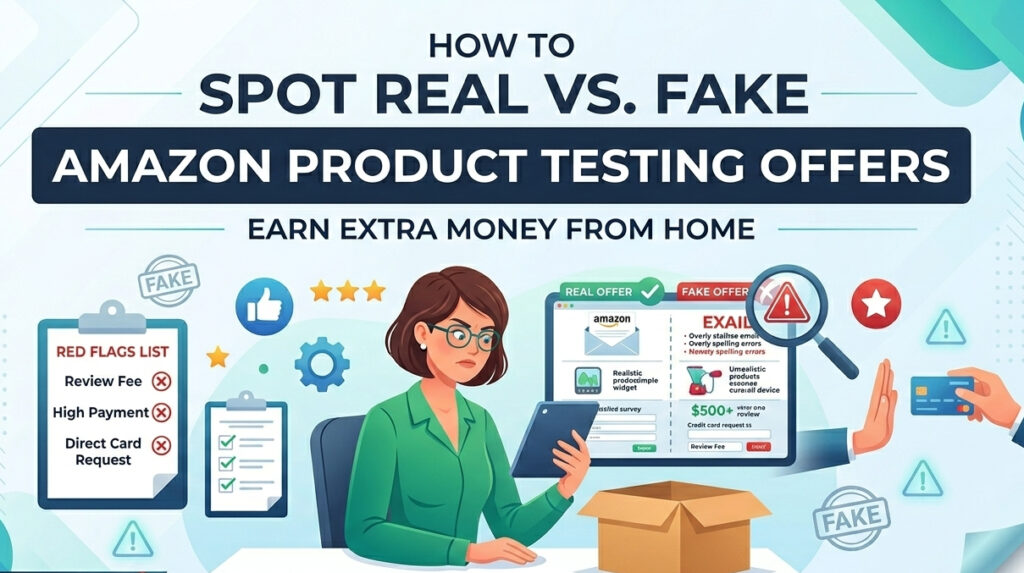
Legit Signs
- Clear refund or compensation structure
- No requirement for positive reviews
- No request for Amazon login credentials
- Transparent disclosure expectations
Red Flags
- Guaranteed 5-star reimbursement
- Vague “earn thousands weekly” promises
- Requests for sensitive data
- Pressure tactics
If it sounds too easy, it is probably a scam.
Expert Tip: Focus on On-Site Commissions
Most beginners chase free products.
The real leverage in 2026 is On-Site Commissions through the Amazon Influencer Program.
When customers:
- Watch your product demo
- Stay on the product page
- Purchase
You earn without needing them to click your external link.
This compounds over time as your video library grows.
Is Amazon Product Testing Worth It in 2026?
If you expect a stable salary, no.
If you want:
- Free products
- Flexible side income
- Skill development
- Entry into the creator economy
Then yes, it can be absolutely worth it.
The biggest shift is mindset.
Stop thinking like a “review writer.”
Start thinking like a “content asset creator.”
Build credibility.
Choose smart niches.
Follow compliance rules.
Create real value.
And remember, the simplest way to start is still the same:
Write honest, detailed reviews for the products you already own.
Everything else builds from there.
# Written by Elliyas Ahmed